

Mark Van Wagner "Repercussions"
Exhibition Spotlight & Interview: Mark Van Wagner showing at Gallery North

The newest exhibition, Repercussions, at Gallery North showcases Long Island–based artist Mark Van Wagner, as he creates sculptural forms and paintings created from unconventional items, drawing on the world around him. As Gallery North’s curatorial intern, I was able to gain firsthand access to the exhibition and exist within the tension between the natural and the artificial.
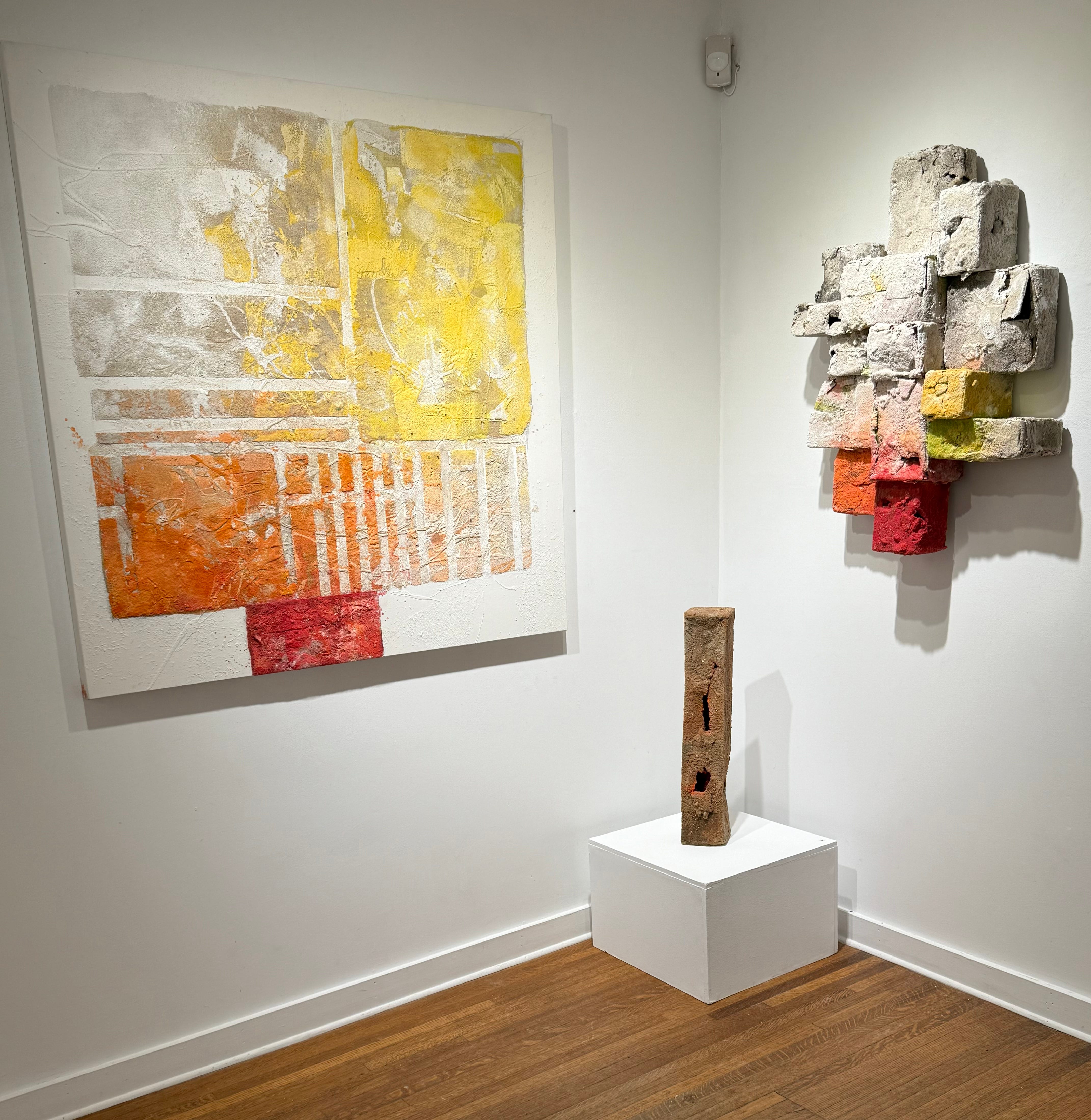
To give some primer, Mark’s material choices emerge as a key point of intrigue, particularly in the way natural and synthetic elements are brought into conversation with one another throughout the exhibition. Utilizing a combination of sand (and the natural sediments that come with it), cardboard, debris, and polymer glue, Mark explains his interest in these materials: “My work is made up of sand and cardboard. I’ve chosen sand because of the incredible process nature goes through to break down all kinds of matter—natural or man-made. Conceptually, I’m interested in the idea of taking millions of grains of sand and applying them to a surface to make something concrete again. There’s a cycle in that… we — or me in this case — transform it again into something new. At the same time, there’s the understanding that it will eventually, over time, disintegrate and return to where it came from. It’s recognition that everything is always in flux and impermanent.”
Mesa Rosa
As you view the sculptures in the exhibition, you’re invited into an almost industrial, dystopian landscape. The statuesque forms extend from the ground at various heights, allowing viewers to imagine them either as natural formations, like trees or geological growth rising from the earth, or as fragmented architectural structures, reminiscent of towers or skyscrapers slowly eroded over time.


As with any exhibition, I found myself drawn to particular pieces, wanting to spend extra time absorbing every texture and wash of color. One of the standout works for me was Mesa Rosa. As the tallest sculpture in the show, reaching roughly my own height, I became captivated by the radiant gradation shifting from deep black to bright fuchsia, blooming upward as if spreading from the root. When I asked Mark about the decision to give the work such an imposing vertical presence, he explained, “While working on this piece, I found myself thinking about all the mesas I’ve stood on in Utah and Colorado. I began to treat the form almost like a column or a butte, imagining the perspective of being on top of it… At the same time, I started thinking about geological core samples pulled from the earth—those vertical slices that reveal the rhythms and layers of sedimentary rock.” Mark refers to the relationship between landscape and geology, drawing on his personal experience existing within nature. Like the exhibition itself, Mesa Rosa’s exterior is layered.
Cry Baby and Surface Tension


The canvas works that make up Repercussions carry over the thematic line of the geometric, structural presence found in Van Wagner’s sculptures. During the time I spent within the exhibition, I found myself returning often to Cry Baby. These works demand prolonged consideration in lieu of leisurely viewing, inviting the viewer to reveal the details of the surface over time. The construction of the sand creates a textured, irregularly eroded surface with shell fragments and interesting rocks embedded throughout. As my eyes roamed the canvas, they caught reflective particles within the sand, creating a slight glimmer that reveals itself as the light shifts across the surface. This became a poignant detail of the piece for me. Mark speaks directly to this experience of distance and proximity: “One of the things I think about a lot is how the work appears from a distance and then what happens when someone moves closer. From far away the surface might not seem so textured or active, but as you get closer you start to see much more—the silica and bits of glass catch the light and glimmer, and the scratches, debris, and layers of sand reveal the history and accretion of time. The surface becomes almost topographical. For me that’s where the real experience happens. The viewer can start to explore the surface the way you might explore a landscape… There’s a whole world embedded in the surface.” In this way, the canvas transforms into an expansive landscape demanding exploration.
Traces of Place
Place is a quiet statement reflected in every grain of sand and sediment. As Mark explains, the decision to take sand from a specific terrain is “very personal,” often tied to “a direct interaction with a place—an environment or ecosystem that has affected someone emotionally, physically, or psychologically.” After speaking to Mark, I was compelled to reflect on my own experiences with memorializing or paying homage to places in my life. It is often the smaller, seemingly insignificant pieces of a landscape, like sand or rock, that reflect the expansive history of nature’s cycles and leave us with an imprint of familiarity and appreciation for well-loved environments. Mark notes that when people send him sand, “that story becomes integrated into the artwork.” Throughout our correspondence, Mark references places like Utah, Colorado, or his home state of Connecticut as his muses, landscapes that continue to inform his work as “a direct homage to the landscape it came from.” For me, it is my grandparents’ home in New Jersey or my parents’ wooded home in Northern Westchester, reminders that every piece ultimately contains “particles from somewhere on this earth.” What might these materials reveal about the evolving relationship between human intervention and the larger ecosystem? As viewers encounter Mark Van Wagner’s sandbox paintings and sculptures through works like Mesa Rosa or Cry Baby, the sculptures and canvases encourage reflection on our own everyday interactions with the natural, the unnatural, and the well-loved landscapes that shape our understanding of place.